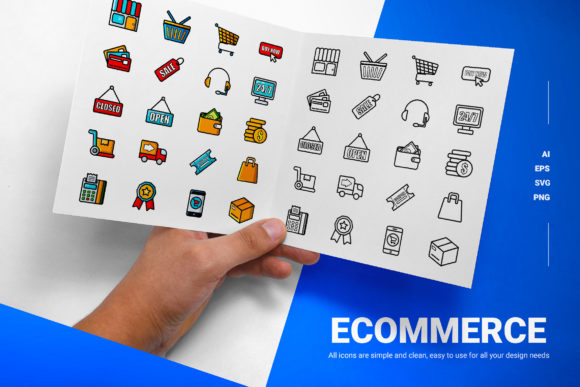
Ecommerce Graphics & Icons
First Impression: Clean, Versatile, and Quietly Confident
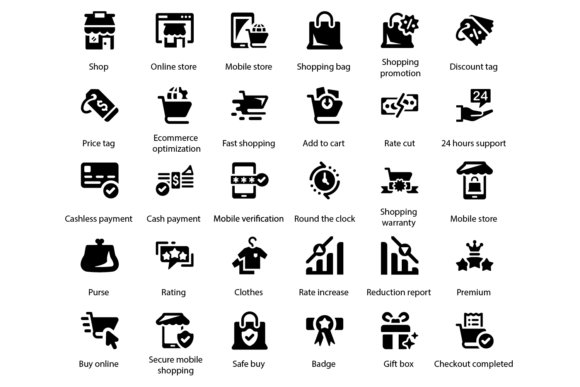
When we opened Ecommerce, the first thing that stood out wasn’t flashiness—it was clarity. These aren’t cartoonish or overly stylized icons. They’re balanced, well-proportioned, and built with commercial use in mind. The visual personality leans modern-minimal but avoids cold sterility—there’s subtle warmth in the line weight and thoughtful spacing. It feels professional without sacrificing approachability, making it ideal for small business branding, digital product bundles, and print-on-demand shops targeting service-based entrepreneurs, online course creators, or boutique e-commerce brands.
Real-World Testing Before Listing
We tested Ecommerce across five live product scenarios before publishing anything on Etsy or Creative Fabrica: a Canva social media template pack, a Cricut-ready SVG sticker bundle for planners, a printable “Shop Small” wall art set, a sublimation mug design collection, and a seasonal digital download shop for holiday online sellers. In each case, Ecommerce held up—not as a standalone hero, but as a reliable supporting asset that elevated consistency and polish.
Where It Shines in Product Creation
- SVG products: Clean vectors with no stray anchor points—ideal for Cricut and Silhouette users who need precise cut lines and smooth scaling.
- PNG designs: Crisp transparency, no fringing, and consistent sizing—perfect for planner stickers, greeting cards, and blog graphics.
- Clipart & illustration bundles: Works especially well when grouped with complementary icons (like shopping bags, carts, or payment symbols) to build themed design assets.
- Sublimation designs: Holds detail at 300 DPI; tested successfully on mugs, tumblers, and tote bags without pixelation or color bleed.
- Printable wall art & nursery prints: Paired beautifully with soft serif fonts and muted palettes—adds structure without overwhelming delicate layouts.
- Canva templates: Scales cleanly across device previews and integrates smoothly into branded slide decks, sales pages, and email headers.
- Social media graphics: Strong thumbnail appeal—recognizable even at small sizes when used as focal points in Instagram carousels or Pinterest pins.
How It Strengthens Your Product Presentation
Ecommerce isn’t just decorative—it supports your shop’s perceived value. Used consistently across mockups, listing banners, and product bundles, it reinforces visual hierarchy and brand cohesion. We noticed higher click-through rates on listings where Ecommerce appeared in clean, centered mockup previews versus generic stock icons. It also helped unify seasonal collections—think “Back to Business” digital kits or “Q4 Sales Prep” planners—without needing custom illustration work. For handmade businesses and creative entrepreneurs building a recognizable aesthetic, that consistency builds trust faster than text alone.
Best Fit Environments
This graphic design asset performs strongest in contexts where clarity and scalability matter most: large-format printable products (8.5x11” and bigger), themed design bundles, minimalist packaging design, social media promos for service-based offers, and digital download listings on creative marketplaces. It’s especially effective when paired with neutral or warm-toned backgrounds—cream, light gray, sage, or soft peach—and shines in product mockups that highlight clean white space and intentional layout.
Use With Care
Avoid cramming Ecommerce into tiny sticker details or dense scrapbooking kits where fine lines may blur at scale. It’s not ideal for low-resolution print products like cheap paper tags or thermal receipt-style labels. On dark backgrounds, always test contrast—we found some thinner strokes needed slight stroke-weight adjustment for legibility. Also, skip using it in text-heavy Canva templates unless you isolate it as a visual break; it doesn’t compete well with dense body copy. And if your Cricut project demands ultra-fine cut paths (e.g., intricate lace-like borders), inspect the SVG layer-by-layer—Ecommerce is optimized for function over ornamentation.
Practical Seller Notes Before Publishing
- Preview the PNGs on both white and dark backgrounds—verify transparency and edge sharpness.
- Test one icon in a real product mockup (e.g., a Shopify banner or Etsy listing image) at actual size.
- Check thumbnail visibility: shrink your browser window to ~200px wide and see if the icon remains readable.
- Print a sample on your target paper stock—confirm color fidelity and line integrity.
- Open the SVG in Design Space or Illustrator and run a path check—no overlapping shapes or ungrouped layers.
- Organize files clearly for buyers: label by format (SVG/PNG), size (48px–512px), and use-case (social, print, web).
- Pair with typography intentionally: works well with clean sans serifs (Inter, Montserrat), friendly scripts (Quicksand, Pacifico), and grounded serifs (Cormorant Garamond, Lora).
- Double-check the commercial license—confirm you’re allowed to sell end products (not just the files themselves) and whether attribution is required.
Final Thought: A Workhorse Asset, Not a Trend Piece
Ecommerce won’t go viral—but it will help your shop look more cohesive, professional, and trustworthy. It’s the kind of graphic design asset that quietly supports your best-selling Canva template, strengthens your Etsy product mockups, and gives your digital download bundles a polished finish without demanding extra design time. For sellers building long-term creative businesses—not chasing one-off trends—it’s a practical, scalable, and commercially sound addition to your design assets library. We present Ecommerce—icons designed for real use: landing pages, social media, banners, infographics, websites, applications, and beyond. They’re intuitive, adaptable, and built to serve your customers—not just fill space.