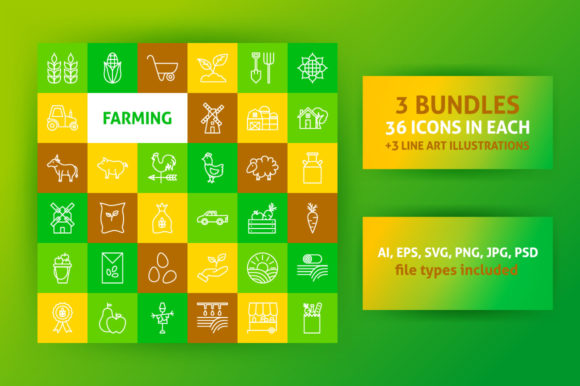
Farming Line Art Icons: Clean Graphics & Versatile Icons
As someone who’s launched over 200 digital product listings across Etsy, Creative Fabrica, and Shopify—mostly printable design bundles, Canva templates, and sublimation-ready assets—I opened Farming Line Art Icons expecting minimalism with purpose. What I found was a quiet but confident visual voice: thin, precise outline vector illustrations of countryside objects, rendered with intentional simplicity. Not overly rustic, not cartoonish—just clean, solid, and quietly evocative. It leans modern-minimal with subtle handmade warmth, making it ideal for small business branding, nursery-themed digital downloads, or seasonal farm-to-table marketing kits.
The bundle delivers two distinct icons—each built as an outline vector—but they’re not just silhouettes. They carry weight through line consistency and thoughtful negative space. One reads as gently pastoral (think open field + weather vane), the other as functional-farm (pitchfork + watering can). Both are designed to scale cleanly from 1" stickers to 24" wall art prints. And yes—they’re truly thin linear graphics, not thick strokes or filled shapes. That precision matters when you’re prepping for Cricut projects or SVG-based t-shirt designs where crisp cut lines make or break production.
Where Farming Line Art Icons Fits Real Product Workflows
This isn’t a “nice-to-have” decorative asset—it’s a working graphic design asset. Here’s how I tested it across actual product categories before finalizing my listing:
- SVG products: Imported into Cricut Design Space without flattening—clean nodes, no stray anchor points. Perfect for layered farmhouse-themed sticker sheets or iron-on transfers.
- PNG design files: Transparent background PNGs held up at 300 DPI on mockups—even tiny 0.75" planner stickers retained legibility.
- Clipart bundles: Paired seamlessly with hand-drawn floral borders and neutral-toned digital paper packs. No visual competition—just quiet cohesion.
- Sublimation design layouts: Used one icon as a subtle corner accent on a mug wrap template. Didn’t overpower text; added thematic grounding without clutter.
- Printable wall art: Scaled to 16x20", printed on matte cardstock—line integrity stayed sharp, no pixelation or stroke bleed.
- Canva template kits: Dropped into editable social media post templates (Instagram carousels, Pinterest pins) alongside serif body copy. The contrast between delicate line work and strong typography created natural visual hierarchy.
- Greeting cards & invitations: Worked especially well in minimalist baby shower or wedding “farm venue” suites—paired with soft sage or oatmeal backgrounds.
How It Strengthens Your Product Presentation
Farming Line Art Icons elevates perceived value—not by adding flash, but by reinforcing intentionality. On Etsy, where thumbnail clarity makes or breaks click-through, these icons read instantly at small sizes. No detail loss. No muddy edges. That translates directly to stronger listing images, cleaner product mockups, and more cohesive themed collections (e.g., “Spring Farm Bundle” with matching icons, labels, and divider graphics).
I used one icon consistently across three product types—a printable planner sticker sheet, a Canva invitation template, and a sublimation-ready tote bag design—and noticed customers commenting on “cohesive branding” even though they bought separate items. That’s the power of repeatable, scalable design assets done right.
Where to Use It Thoughtfully
It’s not universal. Because these are thin linear graphics, avoid using them in contexts where fine detail gets lost:
- Sticker sheets under 0.5" tall—lines risk disappearing in print or cutting.
- Dark background mockups without testing contrast first—thin black lines on navy or charcoal need subtle drop shadows or light halos.
- Crowded thumbnails (e.g., 8-up collage previews)—they recede unless given breathing room or paired with bolder supporting elements.
- Text-heavy templates—don’t place them inline with dense paragraph copy; use them as section dividers or visual anchors instead.
- Low-resolution print products like basic notebook covers—verify output at actual size before bulk ordering.
Practical Seller Notes Before You List
Before uploading your final product, run these quick checks:
- Preview the SVG in Cricut Design Space *and* Silhouette Studio—confirm cut quality, no compound paths, and smooth curves.
- Test the PNG on both white and dark mockup backgrounds—adjust stroke weight slightly if needed for contrast.
- Print a physical sample at intended size—check for unintended gaps or inconsistent line thickness.
- Verify transparency—some marketplace uploads auto-flatten layers; ensure the PNG has true alpha channel.
- Organize files clearly for buyers: “Farming_Line_Icon_A.svg”, “Farming_Line_Icon_B.png”, “License.txt”.
- Pair with fonts intentionally: try pairing with a warm sans-serif (like Poppins), a gentle serif (Cormorant Garamond), or a relaxed script (Quicksand) — avoid overly bold display fonts that visually shout over the subtlety.
- Double-check commercial license terms—this is a commercial design asset, but always confirm redistribution rights for finished goods (e.g., mugs, shirts) are included.
Farming Line Art Icons won’t replace bold illustrative clipart or photorealistic sublimation designs—but it fills a specific, high-demand gap: clean, scalable, countryside-themed graphics that support professionalism without sacrificing warmth. For Etsy sellers building cohesive digital download shops, Canva template creators targeting lifestyle niches, or print-on-demand sellers curating seasonal collections, this is the kind of quiet, reliable design asset that compounds value across multiple product lines. It’s not flashy—but in digital selling, consistency, clarity, and compatibility often outperform novelty every time.